
If your child has ever asked why a metal spoon left in a cup of hot Milo becomes too hot to hold, while a plastic spoon stays cool, you have already seen heat transfer in action. Heat transfer is one of the most important (and most commonly tested) topics in primary school Science in Singapore, and it is also the topic children most often get wrong in exams. In this guide, we break the concept down in simple language, share the misconceptions that trip students up, and give you everyday examples and home experiments to help it finally click.
What Exactly Is Heat Transfer?
Heat is a form of energy. Heat transfer simply means heat moving from one place to another, and it always moves in one direction: from a hotter object to a cooler one. Never the other way round.
This one rule answers half of all heat questions in the P5–P6 syllabus. A hot drink cools down because heat moves from the drink to the surrounding air. An ice cube melts because heat moves from the warmer room into the ice. Cold does not "flow" anywhere, heat does.
The Three Ways Heat Moves: Conduction, Convection and Radiation
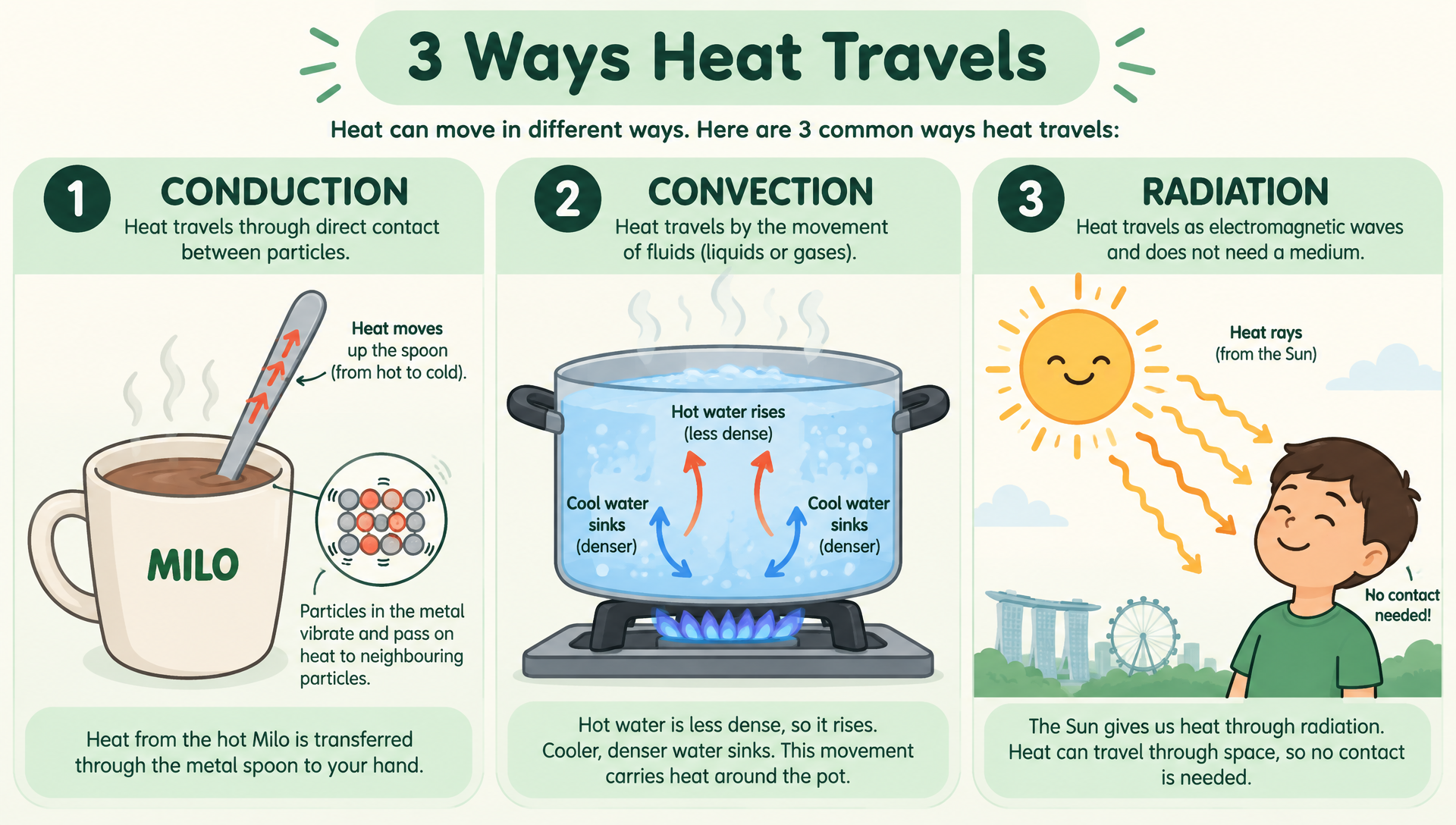
The 3 Ways Heat Travels
1. Conduction
Through direct contact, fastest in solids, especially metals.
e.g. A metal spoon in hot Milo gets hot.
2. Convection
Through liquids and gases, warm fluid rises, cool fluid sinks.
e.g. Soup boiling in a pot; the sea breeze.
3. Radiation
No material needed, travels even through empty space.
e.g. Feeling the Sun's warmth on your skin.
The primary school syllabus groups heat transfer into three methods. Your child needs to know what each one is, what materials it works through, and one or two everyday examples of each.
Conduction is heat moving through direct contact. When you stir hot soup with a metal spoon, heat travels from the soup up the spoon to your hand. Conduction happens fastest in solids, especially metals, which are good conductors of heat. Materials like wood, plastic and air are poor conductors (insulators), which is why pot handles are made of plastic or wood.
Convection is heat moving through liquids and gases. When water is heated, the warmed water at the bottom expands, becomes less dense and rises, while cooler water sinks to take its place, a convection current. This is how a pot of soup boils evenly, and how the afternoon sea breeze forms along Singapore's coastline: the land heats up faster than the sea, the warm air above it rises, and cooler sea air moves in to replace it.
Radiation is heat travelling without any material at all. The Sun warms the Earth through the emptiness of space by radiation, no air or contact required. That is also why you feel warm standing near a barbecue pit even though the air between you is cool. Dark, dull surfaces absorb radiation better; light, shiny surfaces reflect it.
Why Do So Many Children Find This Topic Confusing?
In our classes, the same few misconceptions appear again and again. The good news: once you know them, they are easy to correct at home.
Thinking Cold Is Something That Flows
Children often write that "coldness moves from the ice into the hand". Scientifically, cold is simply the absence of heat. Heat always moves from your warmer hand into the ice, which is why the ice melts and your hand feels cold. Exam answers that talk about "coldness travelling" lose marks even when the final outcome sounds right.
Confusing Heat With Temperature
Temperature is a measurement (in °C) of how hot or cold something is. Heat is the energy that is transferred. A tiny spark from a sparkler is far hotter than a cup of tea, but the tea transfers much more heat because there is so much more of it. Questions that compare "how hot something feels" with "how much heat it gives out" test exactly this difference.
Believing Metal Is Naturally Cold
A metal bench in an air-conditioned room feels colder than a plastic one only because metal conducts heat away from your hand faster. Both are actually the same temperature. Turn it around: on a hot day, the metal bench feels hotter for the same reason. "Feels colder" almost always means "conducts heat away faster".
How Heat Transfer Shows Up in Exam Questions
Heat transfer questions rarely ask for a definition. They hide the concept inside everyday scenarios, and the marks go to students who can spot the method of transfer and explain it with the right keywords.
- Why does an ice cube melt faster on a metal plate than on a wooden block? (conduction)
- Why are the handles of frying pans made of plastic or wood? (poor conductor of heat / insulator)
- Why do we wear light-coloured clothes on a sunny day? (light colours absorb less radiation)
- Why does a sea breeze blow in from the sea in the afternoon? (convection)
- Why does hot chocolate in a metal cup cool down faster than in a foam cup? (conduction)
Notice that every scenario is something a child in Singapore can actually experience. Linking each method of heat transfer to real examples from daily life is the fastest way to make recall automatic during the PSLE Science paper.
Exam keyword tip: Answers earn credit for precise phrases such as "good conductor of heat", "heat is transferred from the hotter object to the cooler object", "convection current", and "absorbs less radiation". Vague phrases like "heat goes into the metal" often do not score.
Three Experiments You Can Try at Home This Weekend
Experiment 1: The Two Spoons (Conduction)
Place a metal spoon and a plastic spoon into the same cup of hot water (an adult should handle the hot water).
Wait two minutes, then carefully touch the top of each handle.
Ask your child: which handle is warmer, and why? Guide them towards "metal conducts heat faster than plastic".
Experiment 2: The Cool Cup Test (Insulators)
Pour the same amount of warm water into a metal cup and a foam or paper cup.
Check the temperature of each every five minutes with a thermometer.
Discuss why one drink stays warm longer, then connect it to lunchboxes and vacuum flasks.
Experiment 3: Dark Versus Light (Radiation)
Leave one black and one white T-shirt (or sheet of paper) in the sun for an hour.
Feel which one is hotter.
Explain it using "darker surfaces absorb more radiation".
The Three-Sentence Answering Technique
For open-ended questions, teach your child a simple structure: identify the method of heat transfer, explain the movement of heat using keywords, then link back to the question. For example: "The metal plate is a better conductor of heat than the wooden block. Heat from the surroundings is transferred through the metal plate to the ice cube at a faster rate. So the ice cube on the metal plate gains heat faster and melts more quickly."
Three sentences. Method, mechanism, outcome. This structure works for almost every heat transfer question your child will meet in primary school Science, and it stops them from writing long, vague answers that never quite hit the mark.
The Bottom Line
Heat transfer looks intimidating because exam questions dress it up in unfamiliar scenarios, but underneath, it is one rule (heat always moves from a hotter object to a cooler one) and three methods (conduction, convection and radiation). When children connect each method to examples they can see in their own home, the concept stops being abstract and the marks follow.
If your child is still finding primary school Science challenging, patient explanation and plenty of real-world examples are the best place to start. And if you would like structured support, our small-group classes at Ang Mo Kio focus on exactly this, building genuine understanding first, then exam technique on top of it.
Want personalised guidance for your child?
Every student learns differently. At AZKEN, Mr Ken Lim designs personalised learning plans that address your child's specific needs and goals.
Mr Ken Lim
Founder & Lead Educator, AZKEN
With over a decade of experience teaching Science and Mathematics in Singapore, Mr Ken Lim has helped hundreds of students build confidence and achieve their academic goals. He believes every child can excel with the right guidance and encouragement.