
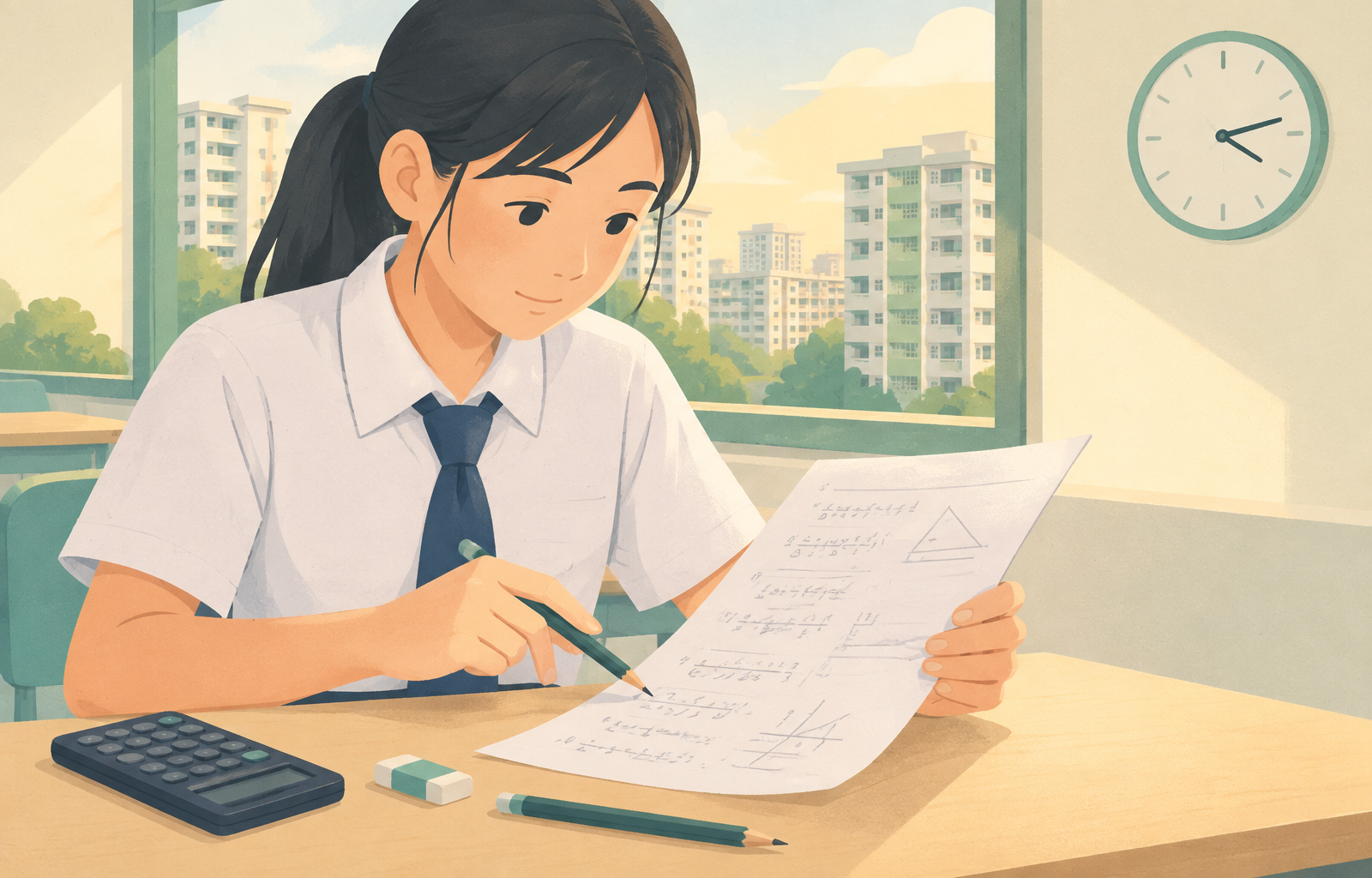
Your child finishes the last question of the Math paper, puts the pencil down, and lets out a sigh of relief. To most students, that moment feels like the job is done. But for the majority of students we mark papers for, the paper is not finished at that point. It is only attempted. Careless mistakes quietly take away more marks than any difficult topic does, and the fix is not more practice. It is checking.
Finishing the paper is not the same as finishing the job
Think about what actually happens in an exam hall. The student flips to the last question, writes the final answer, and stops. The remaining ten minutes, the time set aside for looking through the paper, often get spent sitting still or re-reading questions without really examining anything. The paper goes in with all of its careless slips still inside it.
Here is the part that stings: the examiner marks what is on the paper, not what your child meant. A correct method with a copied-wrong number earns partial marks. A question that was answered but left without a unit loses a mark. None of these are ability problems. They are all found and fixed by a few minutes of proper checking.
Where careless mistakes actually come from
Careless mistakes are not random. After marking thousands of scripts, the same handful of causes appears again and again:
- Misreading the question: answering what the student expected rather than what was asked.
- Copying errors: a number transferred wrongly from the question to the working, or from one line of working to the next.
- Arithmetic slips: small sign errors and mental-math mistakes that a re-calculation would catch immediately.
- Missing units, labels or rounding: the working is right but the final answer is incomplete.
- Skipped questions: a page was turned too fast and one part was never attempted at all.
Notice what is on that list: not one item is about understanding. Almost every careless mistake is a checking problem.
Why checking is a skill, not luck
Parents often tell a child to be careful, as if carefulness is a personality trait. It is not. Checking is a concrete procedure, and like any procedure it can be taught, practised and made automatic. Students who check well do three things the same way every time: they re-read the question, they verify the answer makes sense, and they re-do the arithmetic where the marks are at stake.
The three-pass checking routine
This is the routine we teach in our classes. It takes about ten minutes of a two-hour paper, and it is worth far more than ten minutes of extra solving:
Pass 1: sense check every answer (about 4 minutes)
Re-read the actual question sentence for each part. Did the answer answer that question, not the one the student expected?
Run a reasonableness check: can a shop sell 4.7 pencils? Can a discount make the price higher? Impossible answers are instantly visible.
Confirm units, labels and rounding instructions. S$ or cents, cm or m, 2 decimal places or 3.
Pass 2: re-do the arithmetic (about 4 minutes)
Re-calculate, do not just re-read. The eye skims over its own errors; a fresh calculation catches them.
Prioritise: start with the questions worth the most marks, then the ones where the working felt rushed.
Check every transfer of numbers between lines. Most arithmetic slips are copying errors, not thinking errors.
Pass 3: sweep for losses (about 2 minutes)
Page by page, confirm every part of every question has an answer. Blank parts are the cheapest marks to recover.
Check presentation: numbers are legible, working flows down the page, answers are clearly marked as the question requires.
If any doubt remains on a question, mark it and use leftover time on it, rather than erasing everything in a panic.
Common checking mistakes students make
Checking by staring
Reading the same working again and again finds almost nothing, because the eye repeats its own path. Checking must involve re-reading the question and re-calculating, not just looking.
Using all the time to solve
Many students spend every last minute wrestling with the single hardest question, then rush the final check. One extra mark from checking is usually more certain than one extra mark from a stubborn question.
Erasing everything on doubt
When a student feels unsure halfway through, some start over from scratch and create new errors. Teach them to mark the question, finish the paper, then revisit it calmly during the check.
Only checking the hard questions
Careless mistakes live in the easy questions, where the brain works on autopilot. The hardest questions are the ones a student is most awake for. The easy ones are where the slips hide.
How we train checking at AZKEN
At AZKEN, checking is not advice we give, it is part of how every Math lesson runs. Students practise the three-pass routine until it is automatic, and when we mark their practice papers, careless slips are identified separately from concept gaps, so each child sees exactly how many marks checking recovered and how many it saved. Finishing the paper is treated as the halfway point, never the finish line.
If your child keeps losing marks that they could have scored, this is one of the most fixable habits in the whole subject. Have a question about your child's Math preparation? WhatsApp us at 8166 1212 or book a trial class through our Schedule page.
Want personalised guidance for your child?
Every student learns differently. At AZKEN, Mr Ken Lim designs personalised learning plans that address your child's specific needs and goals.
Mr Ken Lim
Founder & Lead Educator, AZKEN
With over a decade of experience teaching Science and Mathematics in Singapore, Mr Ken Lim has helped hundreds of students build confidence and achieve their academic goals. He believes every child can excel with the right guidance and encouragement.